Sunday, January 8, 2012

Pune@Food, December 15th to January 3rd


Yesterday we went to Sector 31, Gurgaon, to buy chicken and stopped at a vegetable seller’s to pick up some cucumbers. The hawker tried to seduce us with some big succulent brinjals/aubergines/eggplants (Bharta ke liye) but I told him we’d just returned from a place where we just about had enough of the dish. He grinned “Guest House?” 


Well, although the food at the Pune guest house was nice and simple and what we call “homely”, it took some yogic equanimity to put up with endless repetitions of bharta, pohe, dal, chillas, and such. 


I withstood the monotony better than others for I was reared in an Ashram where taste was not the main criteria for food served (I could thus uncomplainingly survive University Hostel food in the eighties-JNU). Also, I was glad of this long break without having to cook and wash up endlessly.


The only alternation was when I accompanied my husband to the University where he was conducting his workshop-again simple Hindu vegetarian fare. Nice. But it was here that I discovered Ragda Pattice
And then there was the trip to Sinhagad where every step uphill and downhill resounded to the cries of Kanda Bhajji


But I had already encountered this crunchy snack over lunch with a fair young translator whom I had only known virtually till then. She took me to 96K - Select Maratha Food and treated me to a nice chill beer (she abstained!) with the ever present masala pappad appetizer and kanda bhajji over talk of Maratha culture. This young atheist discussed books and cuisines while the benevolent Pune sun danced around us. And then it was a light but sustaining lunch of  bhakri with a kind of hot and sour sprouts curry, accompanied by two very hot chutneys-one was made with crushed green chillies and garlic and I don’t know about the other-Thechas?


And then a foodie friend of us joined us on the 1st of January, 2012, and after that it was all kinds of food mayhem from a lunch of Schezwan Dosa, Kada Handi Pav Bhaji and something Indo-Mexican to a dinner (after Sherlock Holmes at E-Square) at a Madurai shack (really light on the pocket and food not bad at all) with a really pleasant young man running the show, followed by Malai kulfis and paan.


Desserts were astrologically doomed for me as the following two anecdotes will reveal. When we returned from Sinhagad, I mentioned Christmas Cake as it was the 25th of December and one of our companions bought a small Xmas cake. After dinner at the guest house, he asked the kitchen staff (a gleeful trio of Nepalis) to bring a knife and plates. The cake was cut and passed around –thin slivers as most of us were full to the brim with the hearty but simple Guest house fare after the long haul up and down hill.  I had muttered something about sharing with the staff and thus, all confused, we left the cake there, not to mention the barfis and chikkis bought at the Macdo on the way there (the time we lost our way in search of the famous hill). The day after that the cake buyer remarked that he could do with a piece and called for it.  The boys said it had been thrown away :D! 


And then after the Shiv Sagar lunch we had bought a small box of sweets as I craved dessert. We headed for the guest house, the men talking Science gobbeldy gook as they handed over the sweets to the kitchen staff. Soon tea was brought to us –in glasses the way they assumed my husband likes it. After a few minutes tiny saucers followed. Our hearts perked up in anticipation but no sweets followed to be served on those :D!


I think it was a cultural misunderstanding-the boys assumed we had given them gifts. I took my revenge by raiding the fridge each time they were out of the kitchen and taking tiny nibbles-the sweets were marzipan like in taste.  
And to cap it all I lent my colour crayons to a six year old friend and they never returned! And when I narrated this series of unfortunate incidents to a person, I had to listen to lectures about lack of charitable nature to boot harumph !


Anyway upon our return to Gurgaon the balance was restored from the Air India dinner rasagoola to a box from Om Sweets and our own small box from Kaka Halwai-an assortment of two types of sweets both very reminiscent of something Middle Eastern-one looked like a mottled salami-some fruit based sweet pulp with a nutty sheath and a fig and cashew paste cuddled by thick khoya arms. And the bakarwadi packet still humbly awaits its fate. 


I conclude this gastronomic vision of Pune by tipping my hat to Air India: I have quite enjoyed my flights to and from Pune, especially the breakfasts. While the mutton dinner on a previous flight was obnoxious, this time the vegetarian dinner was an absolute dear: kadhi and a mixed veg sabzi as main course. The staff is quite friendly if a tiny bit mature and it’s a pleasant journey even given the stuffy nose announcements. 

Tuesday, July 19, 2011

Simple Mealtime Tips To Watch Your Weight

Use a smaller plate
Serve yourself in the kitchen. Each time you want more, you would have to go to the kitchen.
If you want more, wait for 10 minutes before getting it.
Try to count the number of times you chew-they say to chew for a count of 20 to 30.
Eat your light breakfast type meal at dinner and have dinner for breakfast.   

Wednesday, May 11, 2011

Buttermilk@India

Indian yoghurt (dahi in Hindi) is an essential food in quite a few Indian households. Yet it is still a luxury, for I doubt the poor get to have this on a daily basis. Even with the improved economy, a family would need various things in order to make and preserve this yoghurt.
Today, with India as one of the world's largest producers of milk, various milk products are marketed and consumed. 

Where once one had to get the milk at the right temperature (neither too hot nor too cold) before adding the "scatter" (a bit of yoghurt) if one desired a well set bowl of yoghurt, one now merely has to buy Indian yogurt at any shop. 
In North India, Punjab and the Hindi speaking belt, the yogurt is churned with sugar and ice cubes for a nice chilled lassi-often served with lunch. 


To the South, where cow rearing is, for some reason, not so active, Indian buttermilk is more popular. And it is called More!


The yogurt is churned with lots of water, salt is added among other things and this is also served with meals.  

In Tamil Nadu, Karnataka and Andhra, the More is tempered. Pieces of dried red chilli, mustard seeds, curry leaves and other things are spluttered in hot oil and added to the More.


In Kerala More is less. It is called Sambharam and it is even more dilute. 
Recipe
Ingredients
One cup of Indian yoghurt
About 4-5 glasses of water (more or less depending on how you like it)
One small teaspoon of salt
one green chilli broken into bits
a tiny bit of fresh ginger finely diced
Some curry leaves or crushed lemon leaves
Method
Churn it all up and serve chilled
This is the best thing to beat the blazing heat of our summer. 
Here, in India, it's even easier as they now sell Chaanch-buttermilk! I further dilute it and make my sambharam

Wednesday, December 22, 2010

Street Food Gurgaon between Sector 45 and Sector 31

Around the world, the term Street Food has become a catchphrase for trendy places to eat. As with all the lovely things with which the poor are blessed and which bear evidence to God's partiality to the least of creation always, roadside eats are often far superior in taste to the beautifully presented but soulless repasts doled out in Five Star hotels.

I have recorded here a few of the eateries I pass on my way to the gym, Fitness Freak.

This is the first of them

Mostly frequented by workers from nearby places, it serves as tea shop and diner. I have not seen it after dark, but by noon there is a good crowd feasting on hot meals. They also offer snacks like bread pakoras.


The in-between hours are spent in dish washing.

The Second Joint

This lady prepares a daily meal of rotis and a potato curry. As usual with such places, she also provides tea and minor snacks like biscuits. The poor woman has not been keeping well lately. Sometimes her little son helps her and since a few days I notice that they have adopted a stray pup.


Just before the main road, this meals on wheels has a good following at specific times - mostly tea and snacks.


At the cross roads

Another shack provides a slightly wider range of fried snacks. With a cycle repair shop and cobbler in the close neighbourhood, it's a fairly decent location.

 Across the main road

Inaugurating a series of tea "stalls": On a winter morning, hot tea and a spot of sunshine never did anybody any harm.

The second tea "stall"
The man who operates it is courteous and this is probably why he has the better crowd.


Just before the Huda Market, this one opens the series of stuffed roti joints. The rotis are cooked in the tandoor thus making for a healthier version of the North Indian's favourite breakfast parathas.

Hot on its heels is another of the same kind

This one has the better location - more sunshine. To be noted is that, five years on, I find more young men like this running their own eatery rather than working as "chotu" in that of some fat trader type person.


Journey's end for me is a haven of food stops but this one I pass to and fro from my workout: it is an act of great restraint on my part that I have not yet stopped to have a bite for each day there is a big crowd around it paying homage to what must surely be a gastronomic hit.

Friday, December 10, 2010

Roadside Winter Breads-Gurgaon

I have joined a nearby gym to stave off the weight gain that is necessarily incumbent upon a returning Indian eager to make up for lost time but the way to my work out heaven is paved with temptation: at each step a myriad eats shamelessly bandy enticing smells and these two youths start early in the day, impervious to the dipping mercury as they deftly stuff balls of dough, roll them out and shallow fry them before serving them up to the lucky multitudes with sundry garnishes and accompaniments.


When we moved into Gurgaon, somewhere in the late 1990s, eating out was a rare thing, especially in the newer, more urban areas. Our first experience of a take-away was, however, the night we moved in. 

In India, like elsewhere, one mostly cooks on a gas stove but here getting a gas connection was never as easy as, say, in Malaysia where trucks selling gas cylinders slowly roll up and down the streets at least once a day. All you have to do is holler to get them to stop and deliver your fuel. Not so here. In the past, it was a long wait before you were approved for a connection and, in the meantime, you survived on either rationed out kerosene or wood ovens and such. Cooking on electricity existed mainly in colder parts of India, probably, and, most likely, only on campus where it was highly illegal but then students and laws are not famous for their friendship. I write, of course, from memory-of way back in the mid 1980s.

To return to Gurgaon, we had shifted there from another suburb of India's huge capital city and had thus had to "surrender" our gas connection. It would be a while before we got our new connection. 

Tired with a day's worth of unpacking my son and I wandered out of our flat in search of sustenance. It was dark - Gurgaon was far from what it is today and mercifully still very rural. The apartment complexes were at some distance from the old town which would have had its restaurants and such. 

Luckily we found an eatery at the adjacent petrol bunk: a few rope cots served as table and chairs and the clientele were mainly rugged cross country truck drivers.

I'm not sure such places still exist around here, at least not in the bustling urban perimeters.  By the early 2000s change rapidly manifested, largely initiated by the burgeoning call centre culture. My son, who then worked in one of those, would know more about what was what in the night food scene of Gurgaon in those years. 

He speaks of an amazing biryani, for example.

In between we moved to Kuala Lumpur for five years and returned ravenous with nostalgia for Delhi's tongue tingling variety of foods. Not a day went by but we discovered how much had changed:prices had skyrocketed past any normal inflationary margins, all kinds of world cuisines were represented where before all we had was the wonderful Indian Chinese...

We arrived back in Gurgaon late at night in July 2010 and my husband set out with his friends, who had so kindly picked us up from the airport - in search of a bottle of drinking water. However, all he returned with was some delicious aloo ka paranthas, a fine dal and mosambi juice! 

While dal is a staple in any North Indian eatery, the aloo parathas and juice were a new addition for me. Chappatis were common but not as common as the ubiquitous tandoori rotisNaans did grace some posh eateries. Around the time we left for KL, Khameera rotis had begun to make themselves known. Aloo parathas did indeed exist on the roadside but, as they were mainly the prerogative of the housewives to make, they humbly lurked in some odd roadside stall or at railway stations in some remote place. 
  
As that fine upstanding stalwart, the Indian Housewife, had to part with her sons and daughters who now flew from the nest earlier and further with the new and plentiful job opportunities, Mother India had to provide for the grass orphans. The famous and formidable belna had to be graciously handed over to various Tanvirs, Dharamvirs and Haris. Stuffed rotis, the breakfast staple of North India, now graces every street corner and, as night shifts continue to plague this land, are served at all hours. 

Monday, September 27, 2010

Sweet, Sour, Spicy Karela Fry


Karelas are bitter. Some more so than others. Normally, in India, at least, things that taste awful, especially bitter things like Neem leaves, supposedly do you a lot of good. With this in mind, every good Indian mother cooks some Karela now and then, if not for the welfare of her family then out of sheer sadism.

By à´•ാà´•്à´•à´° (Own work) [CC BY-SA 3.0], via Wikimedia Commons
Well, my mom felt she had a lot of things to be bitter about, or maybe it was just the way we perceived her but she cooked our karelas in such a way that it was positively wicked rather than “good for you” awful. As a matter of fact, my husband swears he got to love this abomination only after we met and I seduced him with a dish of this ugly green vegetable. My son still refuses to have any but then he is one of those who think that vegetables are merely there to provide fiber.


Anyway, the recipe is fairly simple:
Sweet, Sour, Spicy Karela Fry
3 small karelas
2 medium sized onions


For soaking:
A small lime sized ball of tamarind
Loads of oil
 
For tempering:
½ tsp cumin seeds
½ tsp red chili powder
¼ tsp turmeric
½ tsp grated jaggery
 
Method
Chop the karelas into thin roundels. De-seed, if possible, although a few seeds add a delightful crunch.


Soak the roundels in water to which you have added the tamarind (squeeze the tamarind a bit to make the water sour) for as long or as little as you desire.


Drain the roundels well (to avoid spluttering – both you and the oil - when they hit the hot oil) and deep fry them in hot oil. 

Add a few roundels at a time if you are more patient than I to achieve uniformly browned but not burnt roundels. 

Drain them and keep them aside.


Chop the onions – not too fine. 


Heat a wee bit of oil-maybe a couple of tbsps? 

Add the cumin and when it has spluttered enough, add the onions. What do I mean by enough? That depends - some like them to get almost charred (I know my good man does!) and some, like me, prefer that they just barely cease to splutter. 

Fry the onions well. Again, you might prefer them to just get translucent or, on the other hand, maybe you like them well-browned. 

Add the karela roundels and the chili powder, salt (Don’t tell me I have to tell you how much! Okay, about ½ a tsp?), turmeric, and, finally, the grated jaggery


If all this is too complicated, just add some lime juice for the sour and some sugar for the sweet.


Serve with hot white rice or puris or chapattis.

Sunday, November 15, 2009

Bangalore, eating out in Sixties

When I was a little girl, in Bangalore, in the Sixties, my father often took us out to eat, mostly at Koshy's where I rejoiced in the high chairs onto which I was hoisted, the Malayalee waiters who addressed me as Geeda, the Chicken Mayonnaise which I ordered and remains unmatched in my memory for it’s yellow mustard tang. My sister rejoiced in her Russian Salad - when she was not being a total vegetarian and I somehow remember that we had to drive past a Christian graveyard. But what is for sure is that it was Koshy's that left us a family joke of waiters who clear away tables before you finish eating.

I do not remember where in Bangalore my mother was eating Rogan Josh when my father’s friend joked that she (who was very pregnant with me at that time) was surely going to have twins who would be named: Rogan and Josh. I do not know what Rogan means but I certainly can boast of having more than my share of Josh (liveliness) and, if I rightly recall, the famous Woodlands came into our lives towards the end of our stay in Bangalore - at least the celebrated paper dosa

It is interesting to see that Indian food came into my life later with the normal family meals being fried eggs, thick finger chips, canned fish, cheese toasts and the like - although I think that was basically it. I wonder if it is small wonder I always ran away from food at that age. 

I had not, you see, unlike my parents and sister, just returned from England and, thus, the charms of delicacies such as mashed potatoes or caramel custard still elude me. And Western food would have to be the Malayalee Chicken Mayonnaise or nothing. 

For all the honest efforts of my well meaning parents to convert me to what they must have considered “civilized” foods, I mainly cherish the memory of kesari bhath and another dish of rice that was savoury instead, from my childhood in Bangalore. Let me sweeten my sour words from above by recalling the amazing sweets of Bluebells, a sweet shop which was next to an antique shop at which my dad bought many beautiful Hindu curios – a bear which I have inherited (I hope I did not confiscate it) which represents Jambuvan
to me. 


Jambuvan was important to me as my dad used to allay my childish fears by telling me that Jambuvan was standing in the bushes outside in the garden to protect me. 

At the same shop he must have bought a little stone Hanuman which lay in the glove compartment of our Humber Hawk until the car was sold when we left for Pondicherry. 

There was also a kind of brass mini temple which housed a few of the gods who graced our make shift puja rooms. This one often caused cuts on the hands of whoever was saddled with the task of cleaning it. 

I seem to have digressed from pet pooja (tummy worship) to matters of which I shall write more elsewhere, namely what Hinduism means to me. But ramblings often lead to the right roads and so I shall end today’s pilgrimage to the past with an elegy to my mother’s prasadam for Satyanarayana Puja:
Ingredients
Suji(Semolina) - any decent amount such as a small cupful
Ghee (clarified butter) - since any amount is indecent, use sparingly as in, maybe a Tbsp? Or two
Sugar – to taste (ranging from half a cup or more to a couple of tsps) 
Raisins – ¼ cup
Chopped nuts (Cashew or almond) ¼ cup
Bananas – 1
Method
Roast the suji in ghee until the aroma makes you faint. When you return from the hospital or to your senses, cool it a bit after you have also cooled down yourself. Add sugar and raisins and chopped nuts and bananas. If religious and conversant with rituals, perform the puja.

If not instantly perform the stomach worship ritual by eating it up. The recipes on-line seem to add milk which is not what mom did –so there!

Thursday, June 4, 2009

Going Bananas

The other day I gave in to the desire to eat pisang goreng (Malaysian banana fritters). There is a little stall opposite the Jusco side of Pearl Point where a lady, who looks like an illustration from a Russian fairy tale in her long sleeved long gown and scarf, sells various fritters (sweet potato too). The stall is decorated with several kinds of bananas.

However she is not per se a banana seller and so she was rather taken aback when I asked to buy one large banana.

After I had sufficiently wooed her and overcome her horror at my request, I also made so bold as to ask for 1RM worth of the sweetest variety.

The batch of pisang goreng that I bought was pretty good -sweet which is rather the exception here as I suppose the real sweet tooth lives only in India and the rest of the world can be wimpish when it comes to the sugar quotient of a dessert.

Now I must tell you that we have such a dish in India (Kerala) where it is called pazham pori (The recipes given online all contain sugar but that is not the way my sister-in-law made it so far as I remember. It was her preparation that I first tasted).

Growing up in South India, especially in Pondicherry, I was exposed to so many varieties of bananas. Alas! We were not so well off and I was too small to make my desires well known and so I did not, then, get the chance to taste the amazing range that I could see being sold on the roadsides.

And then I grew up and married a man from Kerala, the real place for going bananas in India. It is thus that I encountered the custom of having steamed banana for breakfast. The type of banana used for this is gigantic. This is chopped into large pieces and steamed in its skin and then eaten with Kerala poppadoms.

It is an amazing dish and, in our case, we added some carrot chutney as side dish to spice up things.

Below, a cute look at how it's made!

Sunday, March 22, 2009

Indian Vegetarian Chow Mein

Way back, when we were in Malaysia for some years, though we thoroughly enjoyed the food there, nostalgia sometimes dictated a meal of Indian Chinese.

My first taste of Chinese was in Hyderabad, way back in the Seventies. I recall some truly yummy Sweet and Sour.


Later, in Delhi, we had some delicious dishes at the Golden Dragon


So here's my recipe for Indian style Chinese noodles or Chow-Mein.

Ingredients

One packet Ching's Secret Hakka Veg Noodles.
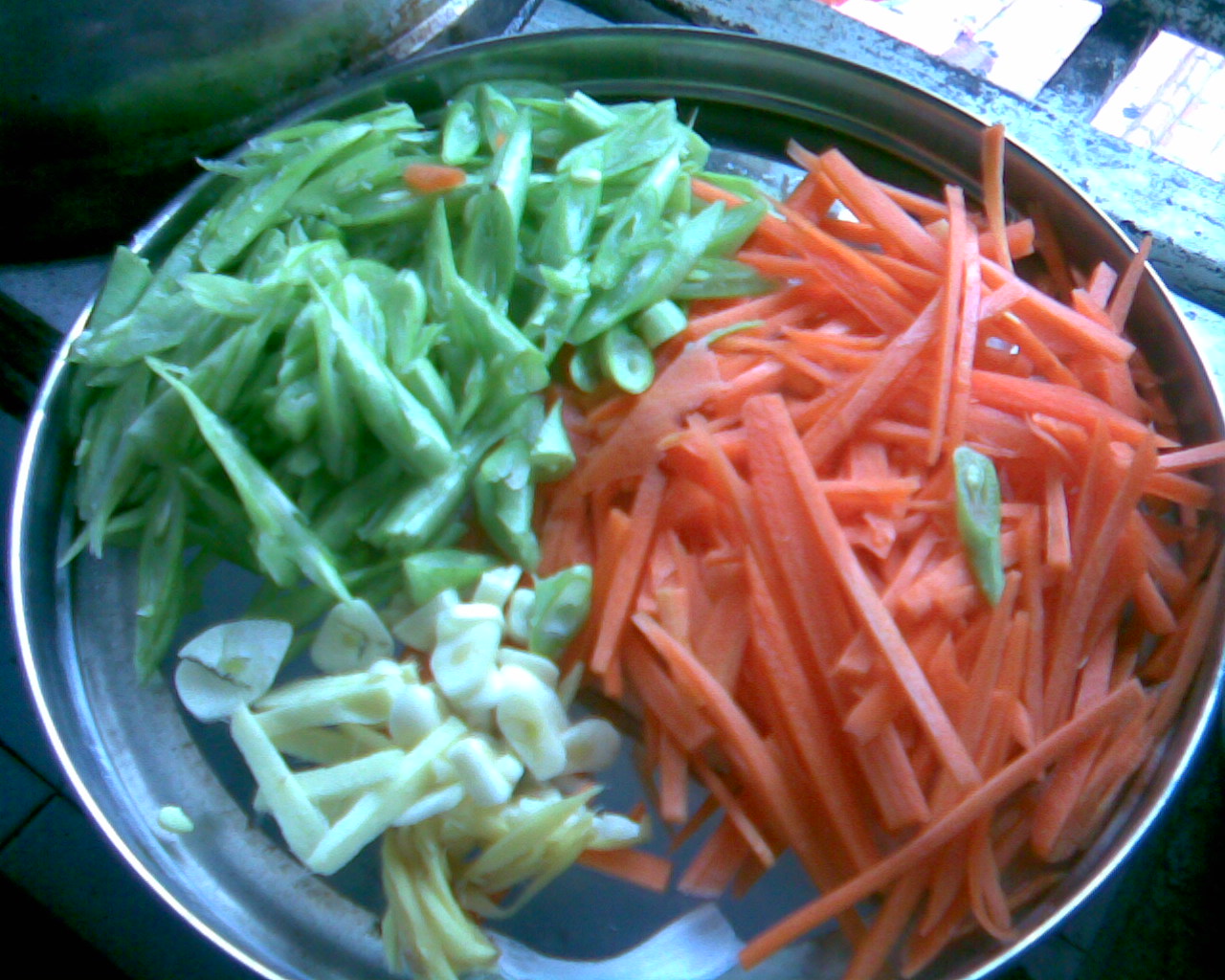
About one cup each of vegetables like french beans and carrots, thinly sliced.
A couple of cloves of garlic and a small piece of fresh ginger, also thinly sliced.
Some dried red chillies (optional)
4 Tbsp Oil (or less!)
Salt to taste


Method

Boil 8 -10 cups of water. Drop in the noodles and boil them for only 2 minutes.
The noodles should be al dente (slightly "kachcha").

Drain the noodles and run cold water over them in the strainer.
Keep them aside to cool and rub in 1 teaspoon of oil to prevent sticking.

Heat oil on a high flame. Add the chillies.
Add the vegetables and stir-fry for a couple of minutes.
Take this out and add some more oil and lightly fry the noodles.
Combine them with the veggies and a dash of soy sauce and vinegar or be adventurous like me and use Chinese cooking wine and oyster sauce.
Add salt if you must.

A How To from YouTube:

Serve with Chilli Chicken (Featured in tomorrow's blog post!)

Thursday, January 22, 2009

Baingan ka Bhartha (Roasted eggplant dish)

INGREDIENTS
1 round eggplant
2 medium sized onions
1 small tomato or half a large one
Green chillies to taste

A couple of cloves of garlic

Half the amount of fresh ginger
1 Tbsp oil
1/2 Tsp cumin seeds
1/4 Tsp turmeric powder
1 Tsp or less red chili powder
Salt to taste (Start with about 1/2 a teaspoon)
A small bunch of fresh coriander leaves

METHOD
Take one medium eggplant and rub oil all over the skin. Roast it.

Dunk it in water 
to remove the burnt skin.
Finely chop onions.
Chop the tomato, ginger, garlic, green chillies 
and coriander leaves.
Heat about one tablespoon of oil in a pan
Splutter some cumin seeds. 
Add the onions and saute till translucent. 
Add the tomato, ginger, garlic... 
Add the green chillies and the turmeric and red chilli powder
Add the roasted and peeled eggplant. 
Mix well and cook for a second or two, mashing the eggplant well with the ladle.
Garnish with the fresh coriander leaves.
Serving suggestions:
With hot rice, chapatis, bread... My son used it to make a turkey breast sandwich!