Friday, April 13, 2018

Is Bee Wilson the New Buzz Word? Is the Takeaway "Spare the Rod and Sapere the Child?

Now, more than ever before, people are interested in the concept of nutrition. Questions of what one should eat obsess and not a day goes by that we don't surf the Net to find out what's what in matters of food. It's a positive sign, I'd say, for food appears to be an important cornerstone of our beings.

This blog plans to stir in a dash of books, now and then, to the usual menu of recipes and such. My other blog, Itiuvacha, devoted to books, indulged in a series of posts about food in fiction. 

A Slice of Danish Noir and Food Fiction - The Junior Taste Count were well liked and my primary interest remains books. Thus, even on a food blog, I would ultimately lapse into a look at books. There are many possibilities there and, as seen above, the tastiest munch has already been had at the other blog. 

However, there is also the concept of the recipe book that I plan to explore here and, as mentioned in the introduction, nutrition concerns continue to intrigue us.    

Once upon a time, in India, the first solid feeding of a child was a very serious matter. All sorts of rituals were involved. And then came Spock. After that there's been no looking back! And, so, we begin the blog's journey into books with baby steps, as it were:


Bee Wilson, British food journalist, writer and historian with five books to her credit, tackles how food preferences develop. In her own case

she traces this instinct to a ritual she had with her father when she was a teenager. Her parents had just split up, and whenever her dad would send Wilson on a train back to her mother’s house, he’d buy her a magazine and a box of chocolate-coated malted milk balls, something that, before her parents’ divorce, would have been deemed a special-occasion treat. She felt powerless to refuse the candy, even as she was struggling with a disconcerting weight gain. It took Wilson years to realize that her father’s gesture was as much about making him feel like “the generous provider” as it was to reward her with a happy sugar high. She writes: “To give a child the things she loves to eat bestows a heroic glow. It feels almost as wonderful as eating.” Beatrice Dorothy "Bee" Wilson (born 7 March 1974) is a British food writer, journalist and historian and the author of five books on food-related subjects.eatrice Dorothy "Bee" Wilson (born 7 March 1974) is a British food writer, journalist and historian and the author of five books on food-related subjects.
Beatrice Dorothy "Bee" Wilson (born 7 March 1974) is a British food writer, journalist and historian and the author of five books on food-related subjects.Beatrice Dorothy "Bee" Wilson (born 7 March 1974) is a British food writer, journalist and historian and the author of five books on food-related subjectsSUNDAY BOOK REVIEW

The take-away:
Our first mistake, she argues, is to wait until six months before weaning our babies (research shows that between four and seven months babies are extraordinarily receptive to flavour) and our second is to start them off with bland, honeyed flavours like carrot and sweet potato rather than more challenging vegetables such as spinach and broccoli or courgette, acquainting them with green and bitter taste sensations. But her most useful tip for the generously proportioned: use smaller plates.
And
3 lessons from Bee Wilson’s First Bite:
Kids make better food choices than you think – if you let them.
Your parents might make your children fat, in spite of having good intentions.
Learn to tell hunger from appetite to make sure you don’t take in unnecessary calories.

Reviews vary from those that accuse her of adding too much emotional flavour to her writing:
In addition to describing such dire disordered eating, Wilson devotes a lot of space to more basic everyday bad habits. She explains how they develop—largely as a result of the food environment in which we learn to eat—and how we can overcome them. Being open to new food experiences is a start. At times, Wilson's critique feels cloying, beating on overdone consumer health tropes, including the obesity epidemic and the pitfalls of a “Western” diet. She injects some levity into these weighty discussions, however, when she describes how she would often blitz through tubs of ice cream as a teenager.

to those which find it too devoid of the touchy-feely:
As I read First Bite, I sometimes felt that for all its good sense, its tone was just a little too measured. A touch of anger wouldn’t have gone amiss; sometimes, you want to feel a writer’s engine thrum. But this is a small thing and for most readers its author’s intense curiosity will be enough. What’s ultimately wonderful about it is the way it sends you back to the development of your own palate. I thought of my parents, rather strict in the matter of food, and my siblings, some pickier than others, and finally my famously fussy husband, at which point bewilderment rushed in all over again – for the only thing in all the world that I would not choose to eat is celery. How did this happen? Perhaps I am not a woman at all.


Another bias:

At times we hear a little too much about spaghetti puttanesca, kale salad and other food choices available only to a small minority of people with access to chic markets and cookbooks by Gwyneth Paltrow, but her insights are invaluable.

And here's what the author herself has to say:


The question for me would be: how relevant is this to us in India? 

While the book might or might not be a nourishing read, I'm grateful to the chance to read about it because I learned of an amazing concept from Finland that Bee Wilson discusses in First Bite.
In 2004, the kindergartens of Jyväskylä, a lakeside city in Finland, received funding to give all children aged one to seven instruction in “varied food habits”. These lessons were to have little to do with encouraging the children to eat their greens or even with attempting to steer them away from junk food. Instead, they were to explore ingredients with their senses: “the hard crackle of rye crisp bread, the soft fuzz of a peach, the puckering sourness of raw cranberries”. One morning, the children might go out foraging for berries; the next, they might play a sensory game involving the scent of lemons.
The results of this experiment were extremely positive: so much so, in fact, that the lessons were extended to all Finnish pre-schools. Attitudes to eating in children could, it seemed, be radically altered after all – and with them, levels of obesity. Children schooled in what is known as the Sapere movement (from the Latin for “to taste” and “to know”) were not only more willing to try new foods, but less likely to respond to the sweetness of fizzy drinks and other sugary treats, preferring, instead, more punchy flavours. Of course, the study surmised, there would always be some foods they dislike. But if a kid adores beetroot, cabbage, nutmeg and blue cheese, who gives a damn if they can’t stand mushrooms?
Bee Wilson’s account of the Finnish experience of Sapere, in essence, a more egalitarian take on the French concept of savoir vivre, and one in which some 7,000 professionals in the Scandinavian country are now trained, comes towards the end of First Bite, as she looks for pointers to a future in which children (and, by extension, adults) everywhere are saved from a life of addiction to bland and unhealthy processed foods.

Visit the Sapere website to find out more, though the link in the quote above provides a quicker idea.

A scientific paper from 2015 reports a research project to "To evaluate the effect of sensory-based food education activities on children's willingness to eat test samples of selected vegetables and berries." The scientists concluded that "Sensory-based food education activities may promote a willingness to eat vegetables and berries."

The project was carried out in two kindergartens in Finland. The paper also tells us that there is some such concept in France too. I would heartily recommend it to all stakeholders such as parents of the very young, school staff in charge of food, nutritionists of all sorts and it is an easy nibble for all of us, as well. It is good to get to know what scientists actually do - such reading, now and then, can be very nourishing.

However, it is not an easy task to think of setting lifelong eating habits. Though first foods can influence us, there are too many factors that impact how we eat at any given point in life to have any one-size-fits-all approach.

Too much of a desire to blindly obey Bee Wilson's recommendation "Your parents might make your children fat, in spite of having good intentions" has already robbed many children of the traditional ties of bonding with their genetic lineage. Spock probably set that ball rolling ages back and much damage has been done over the years.


Nauzer, from Wikimedia Commons

I have no particular advice to the mothers of the very young, save that prohibiting something or frowning upon it is a very sure way to ensure the child begins to be fascinated by it. Also, if the parents are open to all kinds of food, there is, perhaps, a greater chance that the children will also welcome variety.

Of course, as noted above, nothing can be said for sure but a tolerance, at least, of diversity in food will make better world citizens for a more harmonious tomorrow. In any case, every day, more new foods appear on our horizons than ever before. 

The next post plans to examine the humble tomato, simply because I have some exuberant tomato plants in my little garden and they are merrily productive. 

Tuesday, April 10, 2018

'Fried' Gram - A Versatile Indian Snack Food

There's nothing quite like munching a warm handful of these little roasted lentils on a winter morning walk through a hill station market, or cuddled up with a book, or while watching a spicy Tamil film - it's a just-about-anytime snack. 

Thamizhpparithi Maari, from Wikimedia Commons


Pottu kadalai is, perhaps, more popular in Tamil Nadu than in other parts of India. And more common in the south than in the north. While I was familiar with the look and taste of the lentil in this form, I had little idea what it was. Even now, I can only be sure it is a roasted lentil - probably a kind of chickpea. Channa? I leave it to one of you to enlighten me.

It often figures in 'mixture' from South India, as one of the ingredients. 

சித்திரவீதிக்காரன், from Wikimedia Commons

Though I knew that it was a component in coconut chutney, I later learned that it is not used in the Kerala version. 

Charles Haynes from Bangalore, India (Coconut Chutney), via Wikimedia Commons

It is only recently that I find it's used as base for gravies like sambar or the delicious gravy they serve in some restaurants down south.

Lavanya Kumara Krishnan, thanjavur kadappa ingredients

And that is only the tip of the iceberg! Find below 7 recipes that use 'fried' gram:


Below, channa dal is used instead to make the spicy powder 

'Podis' are salty, spicy powders, made with lentils, red chili and other things. They can be served with idlis/dosas and even with rice. Conventionally, one adds oil, or ghee to them and makes a paste before serving. 

Sankalp Dravid, from Wikimedia Commons


These delicious spirals are a fantastic snack. In homes, they used to be made, in South India, around festival times. Today you can buy them anywhere. 


A rather exotic version!


GoDakshin, - Kozhukattai closeup
Kozhukattai or Kadubu is a special sweet / spicy preparation made during festivals such as the Ganesha Chathurthi (in Septembeer) in India. Filled with a sweet filling of coconut and jaggery in the center covered by a steamed rich dough. Recipe - www.top-indian-recipes.com/blog/5-kozhukattai-recipes-for...

The gram is also used to make sambar!


My favourite is Kadappa, a gravy that goes well with idli/dosa/poori and more.

Researching for this post, I discovered that some women in India appear to use it to delay their period. I've no idea whether there is any research to support this claim. 

Tomorrow, we take off at a tangent and look at some books, for a change. 

Sunday, April 8, 2018

Pep up the Palate with Poppy Seeds

Better known in India as Khas Khas, these tiny off-white seeds are not so commonly used. 

There is a lot of confusion between Khas khas and khas. Khas is probably vetiver and is used as a fragrance, in beverages and to make cooling mats. 

Khas khas is poppy seeds. It was while in Malaysia that I learned that it is banned in certain countries. 

I knew about opium and poppy not only as a pharmaceutical product since my father was a doctor. There was also my mother, originally from the far north-west of India. She had some entertaining tales from her childhood up there. One of them featured a devastating earthquake. People, she said took cover under tables and such. And one person was caught at the Halwai's. This was the local opium addict - very harmless in her narrations. He survived the quake and feasted all through on the shop's goodies until rescued. And, finally, there was opium in literature - Tintin in China is a pretty good idea of all that. 

However, one grew up and soon observed the many diverse truths about all history. And the many faces of laws. 

Back to poppy seeds, there is a moving story about the origins of its use in Bengali cuisine: 

Overnight huge tracts of agricultural land in the Bengal Presidency were transformed into rolling poppy fields and while the native farmer lamented the death of golden harvests, the British raked in a crimson booty. English civil servants fanned out into the western areas of Bengal, into Bihar and Orissa, bleeding a once-thriving agricultural economy dry. Robbed of the produce that fed the family — a miserable state compounded by the ‘aphim’-induced stupor of her husband — the farmer’s wife looked for ways to supplement the meagre meals put together by foraging in forests, ponds and groves. The enormous amounts of dried out poppy seed, left as waste by the colonial masters, suddenly took on an important role. She experimented with it and found much to her delight that the seeds when ground to a paste exuded a nutty flavour, blended well with mustard oil and enhanced the frugal meals of panta bhaat (soaked leftover rice), or boiled potatoes. In the intense dry heat of the area, it also cooled the body. Thus was born the Bengali’s cherished posto. As Banerji observes: “An added bonus is its slightly soporific effect, which deepens the post lunch siesta for an ease loving Bengali”.


I first came across it for use in cooking when I learned the recipe for a delicious chicken curry from a friend.  

For the curry, a paste was required and it's hard to grind the little seeds. I've managed to get an idea of what to do after digging around the Net: they have to be very lightly roasted till they begin popping and then they are pulsed in a mixer. Over grinding will, perhaps, make the paste too oily. A dash of water might help in the grinding. Pulse in very short bursts to avoid disaster.

Here are some recipes that feature Khas Khas:

Dal

Beverage

Sweets/Desserts


Potato Dishes
TanBanMi, from Wikimedia Commons

Random Dishes

Meat Dishes

As Base for Gravies
khas khas gravy - Mostly non-vegetarian


This post was basically born out of a need to know what to do with the small packet of poppy seeds lying in the kitchen. Tomorrow, I tackle another packet: fried gram. 

Saturday, April 7, 2018

Trying a Tiffin Service - Pune

Tiffin is a very Indian word. When I was much younger it mainly meant a kind of snack. And this was usually reserved for the in-between meal tea times. There are spectacular homemade savouries and, on special occasions, a sweet too. 

By Veera.sj [Public domain], from Wikimedia Commons
A tiffin box is another matter and can range from a small one-dish container to a towering set of containers. A tiffin box is meant to be carried along.

And then there's the tiffin service. Possibly more famous this side of the country since the Mumbai dabbawala is a hoary tradition. However, it must be popular all over the land, now, as more leave home to study and work.

For us, the decision to try one out was an impulse.  We found a local number and began a week back. Since we are both small eaters, one meal more than sufficed. 


The lunch comes in an insulated carrier container as seen above. It's a sturdy contraption and there have been no mishaps. The food is still warm when we eat it an hour after it's delivered.


The little containers have a plastic cover with a small arrangement that keeps them airtight. Often there is a little plastic packet of what I presume is methkoot.


There are four rotis for a person and that's already a lot for us. The rotis are made 'Bombay' style with a light coating of oil. As my mother was Punjabi, I'm somewhat fussy and prefer freshly made phulkas but anything is better than a trip to the kitchen!


The rice supplements our dinner. We are both at the age when it is wise to eat smaller amounts but I would not say that we deny ourselves anything. Eating a light lunch allows for a little snack with tea. If one does not make these small barters, then it is no use struggling with health or weight issues that ensue from the way most of us all over the world eat today.

Some kind of bitter bean and a root vegetable in a crushed coconut masala 

The best part is the vegetable dish. It's usually made in the local style. It's quite spicy for me. This dish is different every day and each one has been fairly new to us. Even the stuffed eggplant, a local specialty, was not really the same as I've had before. The gravy was thinner. The helpings are not lavish but enough for one person with a hearty appetite.


There is a different lentil used each day. We've even had rajma, red beans. As you can see, it's a watery preparation but, again, that's better for the health.

This meal is surely a specimen for the diverse tiffin services around town. At 70Rs per meal it's quite decent. The delivery person was regular and professional. 

We used Nivedekar Tiffin - 98229 18229. This would be good for the vicinity only, perhaps. 

Now, this is not so much about promoting this service but to tell you that tiffin services might be a brilliant way to get to know local cuisine. 

Since we are in Pune, it's Maharashtrian - enjoy the video!


A friend uses Urban Clap for the service. Wherever you are in India, it's not going to be too hard to find and use a tiffin service. The convenience rocks. 

Friday, April 6, 2018

Memorable Slivers of Chennai - December 2016

On the flight to Chennai, as has now become usual for us, we enjoyed a delicious lunch up in the sky - our own home food! And it was only later in the journey that we found we had meal paid tickets. So we used those to buy a box each of cashew and almond as snacks for later.


Due to some mix-up or mess-up, we found ourselves having to fend for ourselves so far as dinner was concerned on our first night in Chennai. We were in an institutional area, rather cut off from things. 

A small walk led us to a little tea-shop where we enjoyed some really splendid black tea with mint and lime and honey.


A young man at the stall gave us some directions and we soon found our way to a little street filled with shops and eateries. 


It was a nice evening walk with hoary and venerable trees lining the peaceful and fairly deserted roads - it was a Sunday. Also, it's an institutional area, relatively free of commercial activities. 


We settled on Sri Durga Bhavan and placed our order. The young chef was busy and dynamic, whipping up take away for other customers too.


A lone seated customer graced the inside. We were a bit too early in the night and I imagine the area comes to life in an hour or so.


There are a good enough number of eateries on that little road and all of them were slowly warming up for the night. Some are family run like the 'mess' below.


We set off for our guest house with our packed dinner. The whole area was slowly stirring into life.


Soon, the shops petered out. The last one was a Modern Bread outlet. Modern Bread was one of the first packaged commercial breads I encountered. We probably picked up some yogurt here.


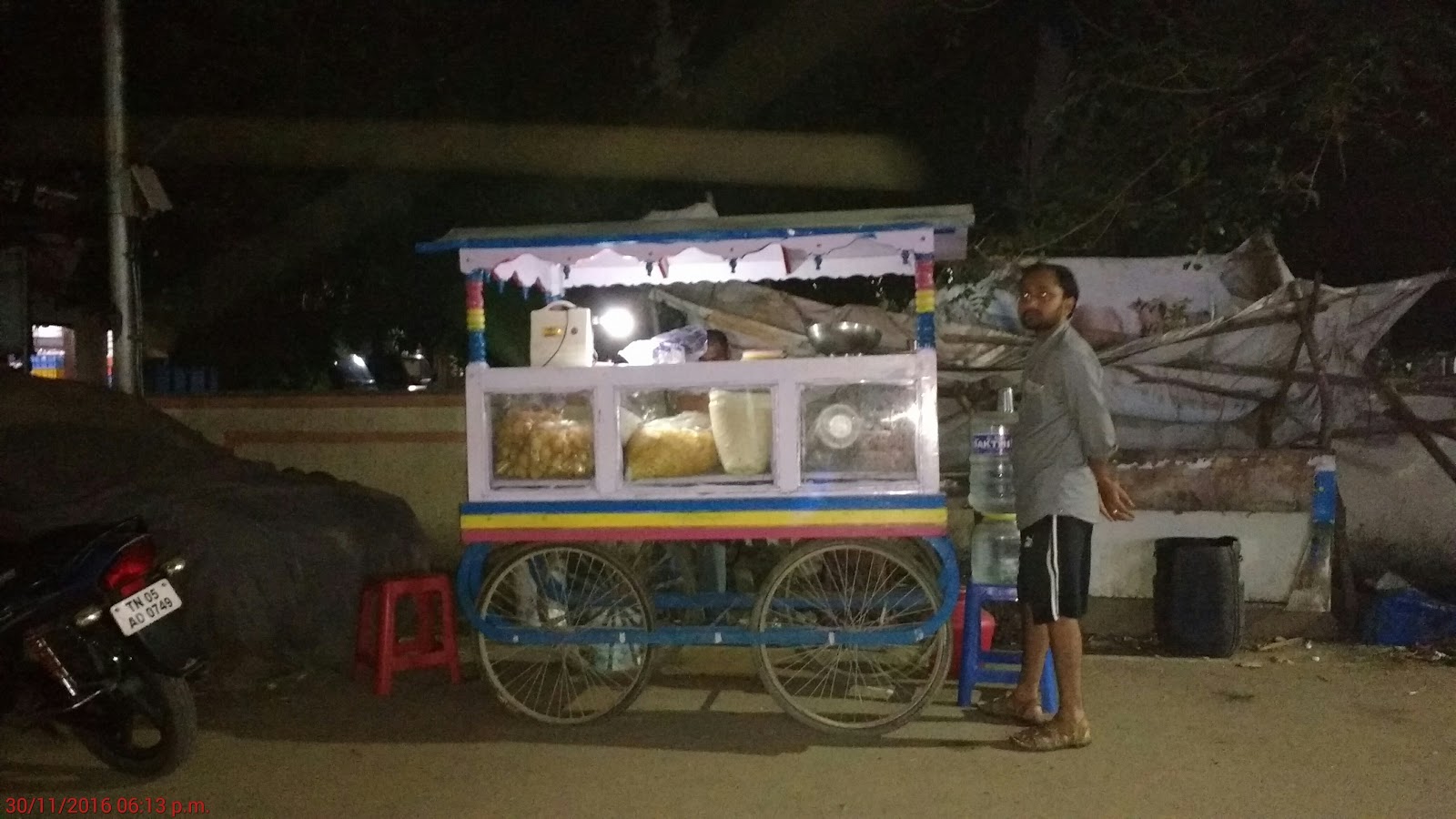
A last lonely cart enticed with promise of fried snacks and hot tea. With so many students around, late night study sessions would demand such fare.


A lonely car amused us with the slogan on the rear window. Amen!


And then, alas, it was a stretch of garbage - however, I do believe that's been cleared up recently. 


Chennai still boasts its pigs as did the Pondicherry of my youth. Obelix should head here!


The next evening we had a tea at this little family run tea stall. 


However, that night, we had a little feast in our room!


At our workplace we got to have some amazing drumstick soup.


Try it for yourself!


And vadas are forever in South India. They also taste best there.


Of course, the best part of many a city is the airport! Chennai airport has some nice eateries now. 


Chennai has many wonderful places to eat at but with my small appetite and reluctance to move around crowded cities, I'm happy with my experiences at places that don't get visited - places where the real people eat. 

Thursday, April 5, 2018

Kerala Fast Food's Kerala Spice

We decided to eat out the other day and decided to go Malayalee. 

At one time, it was not easy to find food from the region in other parts of India. And, when one did, it was quite indifferent in quality and taste. Luckily, Pune, when we moved here, already had quite a few Kerala food eateries scattered around town. We've, basically, only eaten at a couple of them. Including one Onam Sadhya which I suspect was organised by the same restaurant. 

By Irvin calicut, via Wikimedia Commons

Recently we've had a weekend lunch or two at Kerala Fast Food's Kerala Spice


It's always a challenge to provide pictures of the whole experience in an eatery - one hesitates to make people uncomfortable by clicking pictures which might include them. And, if the food is good, it's hard to take a picture beforehand. 


The service is pleasant. The owner( the young man at the counter) is courteously attentive and accommodating. Enjoying a relaxed meal is one of the USPs. There is always a crowd of families, groups of friends, couples and the odd lone eater or two. Everybody studies the menu avidly and orders from a variety of parottas, rice dishes, meat, chicken, fish and diverse vegetables. They have a decent list of beverages and a few routine desserts.   


The Kerala Parotta is a common order and these lads do a splendid job of it. You can buy them, readymade, in the shops but somehow I find those indigestible. It's a complicated procedure. However, here's how you make them:  


We generally order one of those and an appam. There are mixes that you can buy to make them at home and this is what we do, often. Though it's almost as easy then, as a dosa, there's nothing like just ordering it for it goes well with the Kerala gravies.


The food is good and I love ordering a pineapple juice appetiser and a Sulaimani Tea for after. 

As summer has set in, even these rare visits to eateries come to a halt. The latest fad with us is ordering in from a local tiffin service. And I shall share more about that in the next post.

Monday, April 2, 2018

A Breakfast and a Lunch - Small Pune Eateries Enchant

Situated at the corner of a busy road in Pune, Cafe Canada has always enchanted me: why the name? The inside beckoned me to another time and world. Pune has plenty of places like this - buildings that wear a look of history. Humble eateries that take pride in feeding a hungry clientele.


It's not a famous place on or offline but it certainly provided us with a charming experience, including breakfast. 

  
The inside was clean, really spick and span. We ordered a bun maska and tea.

    
As we waited for our order, we drank in the calm and aromatic surroundings.


The tea was perfect as was the bun maska. We would have ordered some takeaway but lunch was not yet ready.


The truth is I am not big on eating out and, in general, avoid going out much. You can see that with such greenery at my disposal I am not eager to join the milling millions.


There is nothing better than working away with this garden to the left and sipping some basil leaf and cinnamon tea.


However, though Cafe Canada is a bit far from where we live, I'm sorely tempted to try dishes from their extensive menu! And, when I do that, I'll post about it. 

In the meantime, Bon Appetit!